99 Names of Allah With Meaning — Complete Asmaul Husna Guide
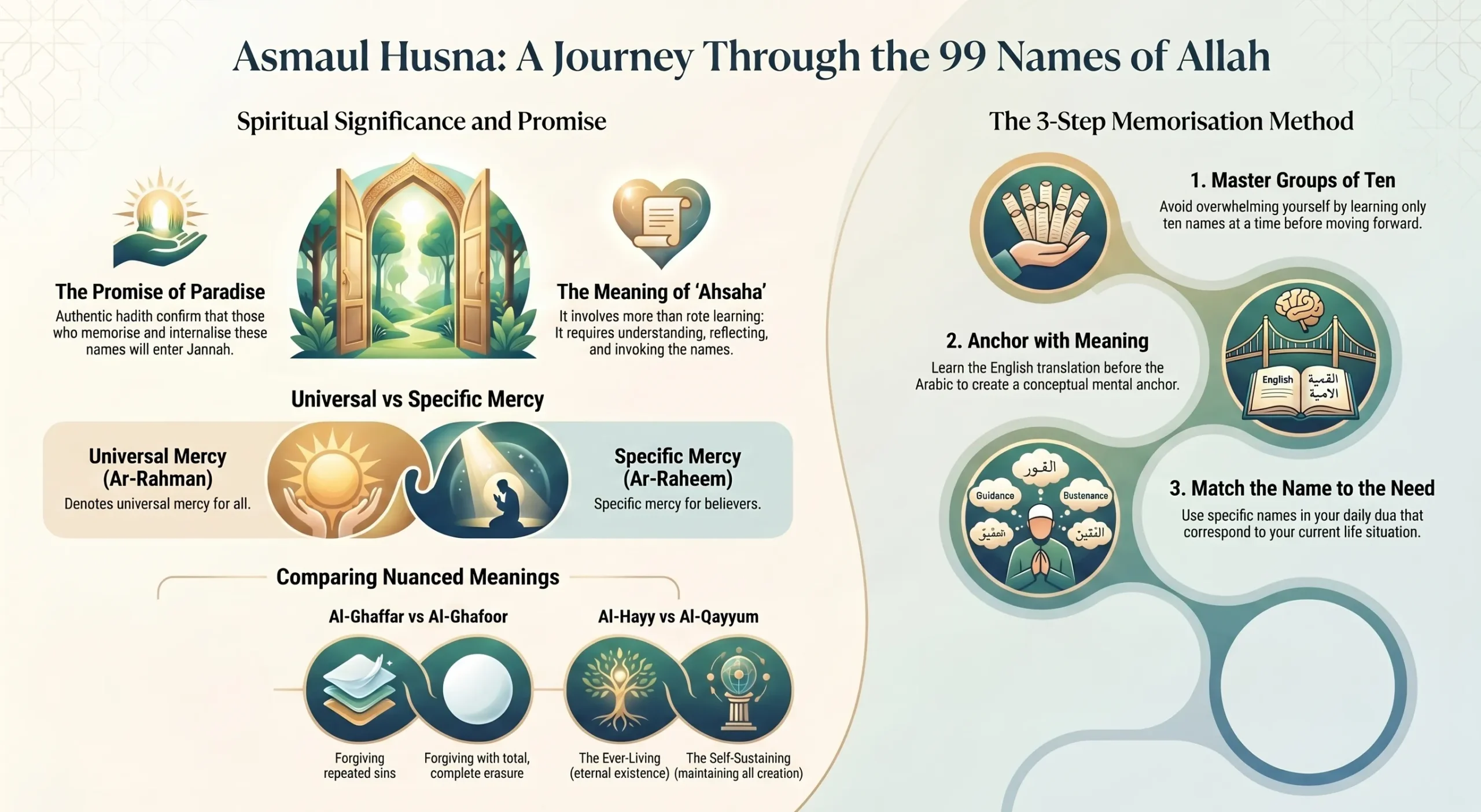
The Prophet Muhammad ﷺ said: “Allah has ninety-nine names — one hundred minus one. Whoever memorizes them will enter Paradise.” — (Bukhari and Muslim)
This single hadith has driven Muslims across 14 centuries to learn, recite, reflect upon, and call upon Allah through His most beautiful names. The 99 names of Allah with meaning — collectively known as Asmaul Husna (The Most Beautiful Names) — are not merely a list to memorize. Each name is a window into a dimension of Allah’s ﷻ reality, a foundation for deeper tawakkul, a source of specific spiritual healing, and a direct path to the divine presence that every believer seeks.
This complete guide presents the 99 names of Allah with meaning in Arabic, transliteration, and English — along with the spiritual significance of the most powerful names, the authentic basis in Quran and Sunnah, and practical guidance for incorporating Asmaul Husna into your daily worship.
Table of contents
- What Are the 99 Names of Allah?
- Asmaul Husna — Names of Allah in Arabic With Meaning
- Names of Allah in Arabic — Understanding the Most Powerful Names
- Benefits of Reciting 99 Names of Allah — Spiritual and Practical
- Daily Zikr Using the 99 Names of Allah
- How to Memorize Asmaul Husna — Step-by-Step Guide
- Pros and Spiritual Benefits of Learning the 99 Names
- Which Names of Allah Are Best for Your Specific Need?
- Conclusion
What Are the 99 Names of Allah?
The 99 names of Allah with meaning are divine attributes revealed through the Quran and the authenticated Sunnah of the Prophet ﷺ. They are not human constructions, theological inventions, or cultural additions to Islam. They are revealed descriptions of Allah’s eternal, perfect reality — each one expressing an aspect of who He is in a way that human language can approach but never fully contain.
The Quran refers to these names collectively as Asmaul Husna — the Most Beautiful Names — and commands believers to use them:
The Quranic Command to Call on Allah by His Names
وَلِلَّهِ الْأَسْمَاءُ الْحُسْنَىٰ فَادْعُوهُ بِهَا
“And to Allah belong the best names, so invoke Him by them.” (Quran 7:180)
This verse establishes calling upon Allah through His names as a Quranic command — not merely a tradition. When a believer says “Ya Rahman” (O Most Merciful) in supplication, they are following a direct divine instruction. The 99 names of Allah with meaning are, at their core, a vocabulary of worship given to believers by Allah ﷻ Himself.
The Foundational Hadith — Jannah Through Memorization
The famous hadith from Sahih Bukhari and Sahih Muslim is the most-cited foundation for studying the 99 names of Allah. The Arabic word used for “memorizes” — ahsaha — is interpreted by classical scholars to mean more than rote recitation. It encompasses: knowing the Arabic, understanding the meaning, reflecting on the implications for one’s own life, and calling on Allah through these names in sincere worship. Memorization alone without understanding falls short of the full meaning of ahsaha.
Asmaul Husna — Names of Allah in Arabic With Meaning
The following is complete list of the 99 names of Allah with meaning — presented in Arabic, transliteration, and English.
| # | Arabic | Transliteration | English Meaning |
|---|---|---|---|
| 1 | اللَّهُ | Allah | The One True God — The Supreme Name |
| 2 | الرَّحْمَنُ | Ar-Rahman | The Entirely Merciful |
| 3 | الرَّحِيمُ | Ar-Raheem | The Especially Merciful |
| 4 | الْمَلِكُ | Al-Malik | The Sovereign, The King |
| 5 | الْقُدُّوسُ | Al-Quddus | The Pure, The Holy |
| 6 | السَّلَامُ | As-Salam | The Source of Peace |
| 7 | الْمُؤْمِنُ | Al-Mu’min | The Inspirer of Faith |
| 8 | الْمُهَيْمِنُ | Al-Muhaymin | The Guardian, The Protector |
| 9 | الْعَزِيزُ | Al-Aziz | The Almighty, The Invincible |
| 10 | الْجَبَّارُ | Al-Jabbar | The Compeller, The Restorer |
| 11 | الْمُتَكَبِّرُ | Al-Mutakabbir | The Supreme, The Majestic |
| 12 | الْخَالِقُ | Al-Khaliq | The Creator |
| 13 | الْبَارِئُ | Al-Bari | The Evolver, The Originator |
| 14 | الْمُصَوِّرُ | Al-Musawwir | The Fashioner of Forms |
| 15 | الْغَفَّارُ | Al-Ghaffar | The Repeatedly Forgiving |
| 16 | الْقَهَّارُ | Al-Qahhar | The Subduer, The Dominant |
| 17 | الْوَهَّابُ | Al-Wahhab | The Bestower of Gifts |
| 18 | الرَّزَّاقُ | Ar-Razzaq | The Provider, The Sustainer |
| 19 | الْفَتَّاحُ | Al-Fattah | The Opener, The Judge |
| 20 | الْعَلِيمُ | Al-Alim | The All-Knowing |
| 21 | الْقَابِضُ | Al-Qabid | The Withholder |
| 22 | الْبَاسِطُ | Al-Basit | The Expander, The Reliever |
| 23 | الْخَافِضُ | Al-Khafid | The Abaser |
| 24 | الرَّافِعُ | Ar-Rafi | The Exalter |
| 25 | الْمُعِزُّ | Al-Mu’izz | The Bestower of Honor |
| 26 | الْمُذِلُّ | Al-Mudhill | The Humiliator of Evil |
| 27 | السَّمِيعُ | As-Sami | The All-Hearing |
| 28 | الْبَصِيرُ | Al-Basir | The All-Seeing |
| 29 | الْحَكَمُ | Al-Hakam | The Judge, The Arbitrator |
| 30 | الْعَدْلُ | Al-Adl | The Utterly Just |
| 31 | اللَّطِيفُ | Al-Latif | The Subtle, The Kind |
| 32 | الْخَبِيرُ | Al-Khabir | The Fully Aware |
| 33 | الْحَلِيمُ | Al-Halim | The Forbearing |
| 34 | الْعَظِيمُ | Al-Azim | The Magnificent |
| 35 | الْغَفُورُ | Al-Ghafoor | The Forgiving, The Pardoner |
| 36 | الشَّكُورُ | Ash-Shakur | The Appreciative, The Grateful |
| 37 | الْعَلِيُّ | Al-Ali | The Highest, The Most High |
| 38 | الْكَبِيرُ | Al-Kabir | The Greatest |
| 39 | الْحَفِيظُ | Al-Hafiz | The Preserver, The Protector |
| 40 | الْمُقِيتُ | Al-Muqit | The Nourisher |
| 41 | الْحَسِيبُ | Al-Hasib | The Accountant, The Reckoner |
| 42 | الْجَلِيلُ | Al-Jalil | The Majestic, The Revered |
| 43 | الْكَرِيمُ | Al-Karim | The Generous |
| 44 | الرَّقِيبُ | Ar-Raqib | The Watchful |
| 45 | الْمُجِيبُ | Al-Mujib | The Responsive, The Answerer of Prayer |
| 46 | الْوَاسِعُ | Al-Wasi | The All-Encompassing |
| 47 | الْحَكِيمُ | Al-Hakim | The Perfectly Wise |
| 48 | الْوَدُودُ | Al-Wadud | The Loving |
| 49 | الْمَجِيدُ | Al-Majid | The All-Glorious |
| 50 | الْبَاعِثُ | Al-Ba’ith | The Resurrector |
| 51 | الشَّهِيدُ | Ash-Shahid | The Witness |
| 52 | الْحَقُّ | Al-Haqq | The Absolute Truth |
| 53 | الْوَكِيلُ | Al-Wakil | The Trustee, The Disposer |
| 54 | الْقَوِيُّ | Al-Qawi | The All-Strong |
| 55 | الْمَتِينُ | Al-Matin | The Firm, The Steadfast |
| 56 | الْوَلِيُّ | Al-Wali | The Protecting Friend |
| 57 | الْحَمِيدُ | Al-Hamid | The Praiseworthy |
| 58 | الْمُحْصِي | Al-Muhsi | The Counter, The Reckoner |
| 59 | الْمُبْدِئُ | Al-Mubdi | The Originator |
| 60 | الْمُعِيدُ | Al-Mu’id | The Restorer |
| 61 | الْمُحْيِي | Al-Muhyi | The Giver of Life |
| 62 | الْمُمِيتُ | Al-Mumit | The Taker of Life |
| 63 | الْحَيُّ | Al-Hayy | The Ever-Living |
| 64 | الْقَيُّومُ | Al-Qayyum | The Self-Sustaining |
| 65 | الْوَاجِدُ | Al-Wajid | The Finder |
| 66 | الْمَاجِدُ | Al-Majid | The Noble |
| 67 | الْوَاحِدُ | Al-Wahid | The One |
| 68 | الْأَحَدُ | Al-Ahad | The Unique, The Only One |
| 69 | الصَّمَدُ | As-Samad | The Eternal, The Absolute |
| 70 | الْقَادِرُ | Al-Qadir | The Omnipotent |
| 71 | الْمُقْتَدِرُ | Al-Muqtadir | The Powerful |
| 72 | الْمُقَدِّمُ | Al-Muqaddim | The Expediter |
| 73 | الْمُؤَخِّرُ | Al-Mu’akhkhir | The Delayer |
| 74 | الْأَوَّلُ | Al-Awwal | The First |
| 75 | الْآخِرُ | Al-Akhir | The Last |
| 76 | الظَّاهِرُ | Az-Zahir | The Manifest |
| 77 | الْبَاطِنُ | Al-Batin | The Hidden |
| 78 | الْوَالِي | Al-Wali | The Governor |
| 79 | الْمُتَعَالِي | Al-Muta’ali | The Self-Exalted |
| 80 | الْبَرُّ | Al-Barr | The Source of Goodness |
| 81 | التَّوَّابُ | At-Tawwab | The Accepter of Repentance |
| 82 | الْمُنْتَقِمُ | Al-Muntaqim | The Avenger |
| 83 | الْعَفُوُّ | Al-Afuw | The Pardoner |
| 84 | الرَّؤُوفُ | Ar-Ra’uf | The Compassionate |
| 85 | مَالِكُ الْمُلْكِ | Malik-ul-Mulk | The Eternal Owner of Sovereignty |
| 86 | ذُو الْجَلَالِ وَالإِكْرَامِ | Dhul-Jalali wal-Ikram | Lord of Majesty and Bounty |
| 87 | الْمُقْسِطُ | Al-Muqsit | The Equitable |
| 88 | الْجَامِعُ | Al-Jami | The Gatherer |
| 89 | الْغَنِيُّ | Al-Ghani | The Self-Sufficient |
| 90 | الْمُغْنِي | Al-Mughni | The Enricher |
| 91 | الْمَانِعُ | Al-Mani | The Preventer of Harm |
| 92 | الضَّارُّ | Ad-Darr | The Creator of Harm |
| 93 | النَّافِعُ | An-Nafi | The Creator of Good |
| 94 | النُّورُ | An-Nur | The Light |
| 95 | الْهَادِي | Al-Hadi | The Guide |
| 96 | الْبَدِيعُ | Al-Badi | The Originator of All |
| 97 | الْبَاقِي | Al-Baqi | The Everlasting |
| 98 | الْوَارِثُ | Al-Warith | The Inheritor of All |
| 99 | الرَّشِيدُ | Ar-Rashid | The Guide to the Right Path |
Note: As-Sabur (The Patient) is also commonly listed as the 99th name in some scholarly compilations.
Names of Allah in Arabic — Understanding the Most Powerful Names
Knowing the full list of 99 names of Allah with meaning is the foundation. Deeply understanding the most theologically rich names transforms that knowledge from information into living wisdom.
Ar-Rahman and Ar-Raheem — Allah’s Double Mercy
These two names of Allah in Arabic appear together in the Bismillah that opens every Surah of the Quran. Recited at least 17 times daily in Surah Al-Fatiha alone, they are the most frequently encountered of all Asmaul Husna. Yet their distinction is one of the most misunderstood nuances in Islamic theology.
Ar-Rahman (الرحمن) describes a mercy that is active, expansive, and universal — encompassing every created being regardless of faith. The rain that falls on the disbeliever’s field, the oxygen the sinner breathes, the sustenance provided to the most rebellious heart — all flow from Ar-Rahman. It is a mercy that exists right now, in this world, as a demonstration of Allah’s generosity without precondition.
Ar-Raheem (الرحيم) describes a specific, targeted, eternal mercy reserved for those who believe and obey — a mercy that will be fully manifest in the Akhirah. It is the mercy that forgives sins, accepts repentance, and admits believers to Jannah. Every prayer for divine forgiveness should invoke Ar-Raheem — the name that speaks specifically to Allah’s mercy for His obedient servants.
Al-Hayy Al-Qayyum — The Living, The Self-Sustaining
These two names of Allah in Arabic appear together in Ayatul Kursi — widely considered the greatest verse of the entire Quran. Together they describe the metaphysical foundation of Allah’s existence.
Al-Hayy (الحي) — The Ever-Living — describes a life without beginning and without end. A life that never weakens, never tires, never ceases. The Quran says: “And rely upon the Ever-Living who does not die.” (25:58)
Al-Qayyum (القيوم) — The Self-Sustaining — means everything in existence depends on Allah for its continued being, while He depends on nothing. Classical scholars described it this way: if Allah were to withdraw His sustaining power for a single moment, the entire universe would cease to exist. Every breath, every heartbeat, every atom’s continued existence is maintained moment by moment by Al-Qayyum.
Ar-Rahman vs. Ar-Raheem — Two Faces of Forgiveness
A common confusion in studying the 99 names of Allah with meaning is between Al-Ghaffar and Al-Ghafoor — two distinct names, both meaning “The Forgiving,” but with critical differences in emphasis.
Al-Ghaffar (الغفار) uses the intensive repetitive form of the Arabic root — meaning one who forgives again, and again, and again. For the same sin. Repeatedly. Without exhaustion. This name is specifically for the believer who has fallen into the same mistake for the hundredth time and wonders if Allah will still forgive. Al-Ghaffar says: yes. Still. Again. Always.
Al-Ghafoor (الغفور) uses the intensive depth form — meaning one who forgives completely, covering the sin as if it never existed. Not reducing, not partially pardoning — fully and completely eliminating the record. This name is specifically for the believer who wants to know that past sins are truly gone, not merely reduced.
Benefits of Reciting 99 Names of Allah — Spiritual and Practical
The benefits of reciting 99 names of Allah extend across every dimension of a believer’s spiritual life — from eternal reward to practical daily protection.
Jannah for Those Who Memorize
The promise is explicit and unconditional in the authenticated hadith. Whoever ahsaha — who memorizes, understands, and invokes Allah through — the 99 names of Allah with meaning, will enter Jannah. This is among the most accessible and comprehensive paths to Jannah documented in the Sunnah, because it requires no wealth, no physical ability, and no specific circumstance — only intention, effort, and consistency.
Understand the Quranic meaning of Allah’s names, enroll in our Tarjma-o-Tafseer Course.
Using Allah’s Names in Dua — The Sunnah Method
The Sunnah method for calling on Allah by His names in dua follows a principle: match the name to the need. This is not superstition — it is the Quranic instruction of 7:180 applied practically.
Seeking provision? Begin your dua with “Ya Razzaq” (O Provider). Seeking forgiveness? “Ya Ghaffar, Ya Ghafoor.” Seeking guidance? “Ya Hadi” (O Guide). Seeking protection? “Ya Hafiz” (O Protector). This practice deepens both the sincerity of the dua and the believer’s connection to the specific attribute of Allah being invoked.
Daily Zikr Using the 99 Names of Allah
Incorporating the 99 names of Allah with meaning into daily dhikr is among the most spiritually transformative practices available to a Muslim. Here is a practical daily framework:
After Fajr: Recite “Ya Rahman, Ya Raheem” 100 times each — invoking Allah’s mercy to begin the day.
During the day (any moment): Recite “Ya Hayy, Ya Qayyum” when feeling spiritually distant or overwhelmed — connecting to Allah’s eternal living presence.
After Asr: Recite “Ya Ghaffar, Ya Tawwab” — the forgiving names — as a daily acknowledgment of one’s need for forgiveness.
Before sleep: Recite “Ya Hafiz, Ya Wali” — the protecting, befriending names — seeking Allah’s protection through the night.
Tasbeeh practice: Using prayer beads (tasbeeh), recite the full Asmaul Husna sequence — one name per bead — as a weekly devotional practice. Many pious predecessors made this part of their Friday routine.
How to Memorize Asmaul Husna — Step-by-Step Guide
Memorizing all 99 names of Allah with meaning is achievable with the right system. These steps build sustainable, long-term retention:
Step 1 — Learn in groups of 10. Never attempt to memorize all 99 at once. Master the first 10 before moving to the next group.
Step 2 — Meaning before Arabic. Understand the English meaning first. When you know that Al-Fattah means “The Opener,” the Arabic word anchors itself to a concept — making it far more memorable than phonetic sounds alone.
Step 3 — Connect names to life situations. When you experience a blessing, consciously recognize “This is Al-Wahhab (The Bestower) at work.” When you face a closed door, invoke “Ya Fattah.” Living the names builds the deepest memory.
Step 4 — Recite daily with tasbeeh. Daily repetition of the names you’re currently memorizing, combined with their meanings, creates the neurological pathways for long-term retention.
Step 5 — Teach what you’ve learned. Teaching the 99 names of Allah with meaning to family members — especially children — is both the most powerful reinforcement of your own memorization and one of the highest-return charitable acts in Islamic tradition.
Pros and Spiritual Benefits of Learning the 99 Names
The authentic benefits of reciting 99 names of Allah include:
Eternal benefit: The explicit hadith promise of Jannah for those who memorize and internalize the names — the highest of all spiritual rewards.
Closer relationship with Allah: Knowing who Allah is — through His own revealed names — deepens iman in a way that abstract theology cannot. Each name is a facet of the divine reality that becomes familiar through study.
More effective dua: Invoking Allah by the name most relevant to your need transforms supplication from recitation into genuine communication — the difference between calling a stranger and calling someone you know intimately.
Spiritual protection: Regularly invoking Al-Hafiz (The Protector), Al-Wali (The Protecting Friend), and Al-Mani (The Preventer of Harm) in morning and evening adhkar creates a documented practice of seeking divine protection.
Community transmission: Teaching the Asmaul Husna to children and community members fulfills the Islamic obligation of knowledge transmission while multiplying the spiritual reward of every person who learns through you.
Full Quran translation in Urdu and English, enroll in our Tarjmat-ul-Quran Course.
Which Names of Allah Are Best for Your Specific Need?
Different names of the 99 names of Allah with meaning are most relevant to specific life situations. Here is how to match the name to the need:
For provision and sustenance:
Invoke Ar-Razzaq (The Provider) — particularly when facing financial difficulty or career uncertainty.
For forgiveness and repentance:
Invoke Al-Ghaffar (repeatedly) and At-Tawwab (The Accepter of Repentance) — particularly after falling into sin.
For peace and anxiety:
Invoke As-Salam (The Source of Peace) and Al-Latif (The Subtle, The Kind) — particularly during emotional distress.
For guidance:
Invoke Al-Hadi (The Guide) — particularly when facing major decisions or feeling spiritually lost.
For healing:
Invoke Ash-Shafi (The Healer) — a name known from hadith though not on all standard compiled lists — and Al-Qadir (The Omnipotent) who has power over all physical reality.
For protection:
Invoke Al-Hafiz (The Preserver), Al-Wali (The Protecting Friend), and Al-Mani (The Preventer of Harm) in morning and evening adhkar.
Conclusion
The 99 names of Allah with meaning are among the greatest gifts bestowed upon the Muslim Ummah. They are a complete divine vocabulary for worship, a manual for supplication, a map of divine reality, and — through the explicit hadith promise — a documented path to Jannah available to every Muslim regardless of their worldly circumstances.
Learning the Asmaul Husna begins with a single name. Understanding begins with its meaning. Living it begins with invoking it in the specific moments of your life where that attribute of Allah ﷻ is most needed. And the journey culminates, InshaAllah, in the paradise promised by the Prophet ﷺ to every believer who takes these most beautiful names to heart.
Begin today. Choose three names. Know their Arabic. Understand their depth. Call on Allah through them in your next supplication. Then add three more. The most beautiful names in existence are waiting to be on your tongue.
May Allah ﷻ grant us the tawfeeq to memorize His most beautiful names, to call upon Him through them with sincerity, and to witness His mercy made manifest in our lives. Ameen.
Explore all our Islamic Courses
Frequently Asked Questions
Q: What is the meaning of Asmaul Husna?
Asmaul Husna (أسماء الله الحسنى) translates as “The Most Beautiful Names of Allah.” It refers to the 99 names of Allah with meaning distributed across the Quran and authentic Sunnah, each describing a real, eternal attribute of Allah ﷻ. The Quran commands believers to call on Allah by these names (7:180).
Q: Are all 99 names found in one place in the Quran?
No. The 99 names of Allah are distributed throughout the Quran and hadith. The specific compilation of exactly 99 is based on the foundational hadith in Sahih Bukhari and Sahih Muslim, with scholars across generations identifying which names meet the criteria of authentic divine attributes.
Q: What does “memorizing” the 99 names actually mean?
Classical scholars interpret ahsaha (the Hadith word for “memorizes”) to include: knowing the Arabic names, understanding their meanings, reflecting on their implications, and calling on Allah through them in dua and dhikr. Rote recitation without understanding does not fulfill the complete meaning of the hadith.
Q: What is the difference between Ar-Rahman and Ar-Raheem?
Ar-Rahman refers to Allah’s universal mercy toward all creation in this world. Ar-Raheem refers to His specific mercy reserved for believers — fully manifest in the Akhirah. Both appear in the Bismillah and together provide a complete picture of divine mercy spanning both worlds.
Q: How long does it take to memorize the 99 names of Allah?
With consistent daily practice of 10–15 minutes — learning in groups of 10, understanding each meaning, and reviewing previous groups — most dedicated students complete memorization of all 99 names of Allah with meaning within 3–6 months. Teaching others and using the names in daily dua accelerates retention significantly.
Q: Can I invoke Allah by a name not on the 99 list?
Yes. Islamic scholars affirm that Allah has more than 99 names — the hadith specifies that He has 99 names that carry this specific Jannah reward through memorization. Allah ﷻ also says He has names preserved in the knowledge of the unseen (referenced in the Master Dua for distress). Invoking Allah by any authentic Quranic or hadith-authenticated name in sincere dua is valid.