Dua for Anxiety and Stress in Islam: Authentic Prayers for Peace and Relief
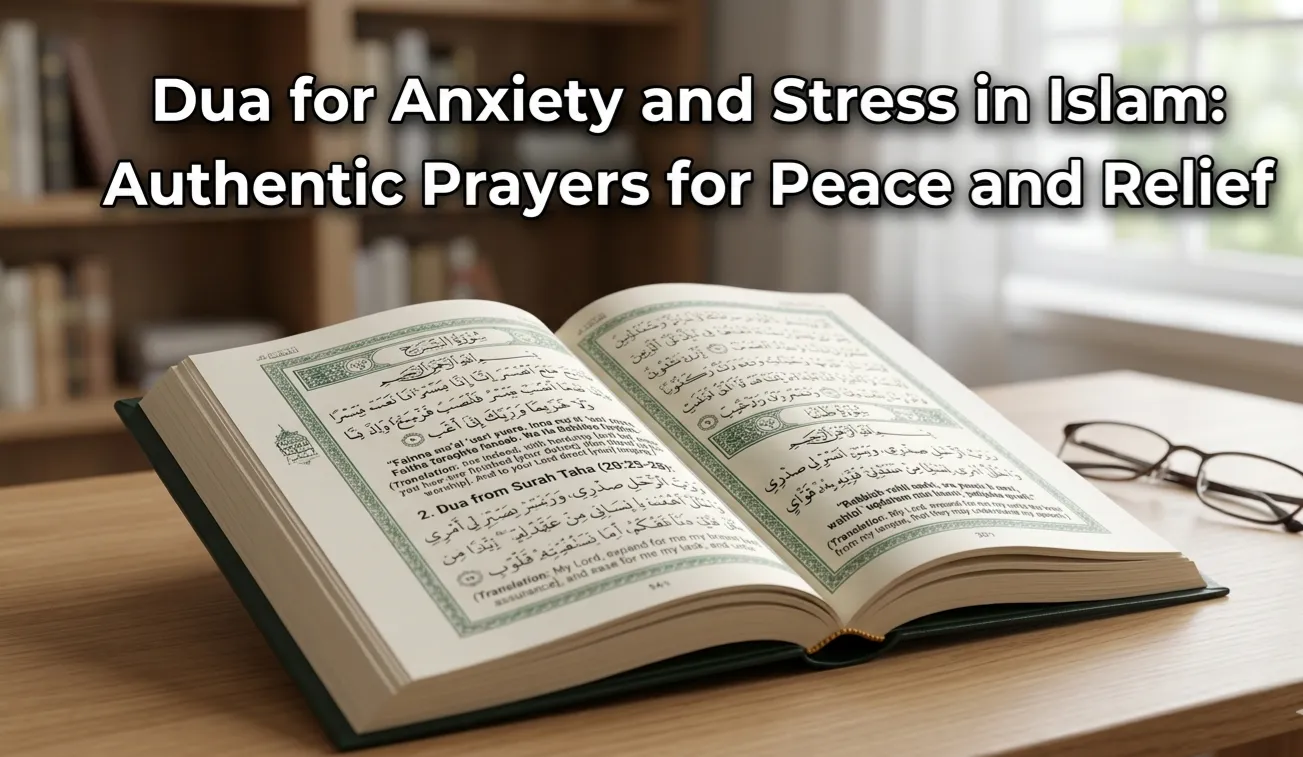
Anxiety and stress are among the most universal human experiences — and they are experiences that Islam addresses with profound depth, compassion, and practical guidance. Whether you are overwhelmed by life’s pressures, struggling with fear about the future, or carrying a grief too heavy to speak aloud, the dua for anxiety and stress in Islam offers something no worldly remedy can fully provide: direct connection with Allah (SWT), the One who controls all affairs and knows every secret of the heart.
The dua for anxiety and stress in Islam is not merely a ritual recitation. It is an act of surrender — a recognition that human capacity has limits and that ultimate relief comes only from the Creator. The Prophet Muhammad (peace be upon him) and the Quran both offer specific, authenticated duas for moments of distress, worry, grief, and fear. These are not general supplications — they are targeted spiritual medicines, prescribed by divine guidance for the exact emotional states millions of people face today.
This guide presents the most authentic and powerful duas for anxiety and stress in Islam, drawn from the Quran and verified hadith collections. It covers when to recite them, why they work spiritually, and how Islam’s broader framework for emotional wellness supports lasting peace of mind — in this life and beyond.
Table of contents
- How Islam Understands Anxiety and the Role of Dua for Worry
- Feature Breakdown: Authentic Islamic Dua for Stress — Verified Duas and Their Sources
- Pros & Cons: Quran Verses for Anxiety — Why Spiritual Practice Works and What It Requires
- Which Is Best? Islamic Dua for Stress vs. Secular Stress Management Approaches
- Conclusion
- FAQs
How Islam Understands Anxiety and the Role of Dua for Worry
Before exploring specific duas, it’s important to understand how Islam conceptualizes anxiety itself. Islam does not view stress and worry as signs of weak faith. The Quran acknowledges that believers will face hardship, fear, and grief as tests from Allah (SWT). Surah Al-Baqarah (2:155) explicitly states that Allah will test believers with fear, hunger, loss of wealth, and lives. Anxiety is not a spiritual failure — it is a human reality that Islam provides tools to navigate.
The dua for worry in Islamic tradition operates through several interconnected mechanisms. First, it shifts the worshipper’s focus from the problem to the Problem-Solver — from the difficulty to the One who removes all difficulties. Second, it creates a physiological and spiritual state of calm through focused intention, breath, and remembrance (dhikr). Third, it reframes the believer’s relationship with uncertainty — reminding them that Allah’s plan is perfect, even when human understanding is limited.
The Quran’s Direct Promise to Those Who Remember Allah
Perhaps the most cited verse regarding Islamic dua for stress is from Surah Ar-Ra’d (13:28):
“Verily, in the remembrance of Allah do hearts find rest.”
This verse is not metaphorical — it is a divine promise. The Arabic word used is ‘tatma’inn’ — a deep, settled tranquility that goes beyond temporary calm. It is the kind of peace that remains even in the presence of hardship. Understanding this promise is foundational to understanding why the dua for anxiety and stress in Islam is so powerful: it is backed by the word of Allah Himself.
Feature Breakdown: Authentic Islamic Dua for Stress — Verified Duas and Their Sources
The following duas are drawn from authenticated Quranic verses and Sahih (verified) hadith. Each has a specific context, transliteration, meaning, and guidance for when to recite it. Together, they form the core toolkit of the dua for anxiety and stress in Islam.
1. The Dua of Prophet Yunus (AS) — For Moments of Deepest Distress
لَا إِلَٰهَ إِلَّا أَنتَ سُبْحَانَكَ إِنِّي كُنتُ مِنَ الظَّالِمِينَ
La ilaha illa anta subhanaka inni kuntu mina al-dhalimeen
“There is no deity except You; exalted are You. Indeed, I have been of the wrongdoers.” (Quran 21:87)
This dua, recited by Prophet Yunus (AS) from within the belly of the whale, represents the ultimate cry of distress and humble admission of human limitation before Allah. It is among the most powerful duas for anxiety and stress in Islam because it combines tawheed (declaration of Allah’s oneness), tasbeeh (glorification), and tawbah (acknowledgment of wrongdoing) — three spiritual acts that together open the door of divine mercy.
2. Hasbunallahu wa Ni’mal Wakeel — For Overwhelming Situations
حَسْبُنَا اللَّهُ وَنِعْمَ الْوَكِيلُ
Hasbunallahu wa ni’mal wakeel
“Allah is sufficient for us, and He is the best Disposer of affairs.” (Quran 3:173)
This was the statement of the Prophet Ibrahim (AS) and later the Prophet Muhammad (SAW) when faced with seemingly impossible odds. It is the Islamic dua for stress that encapsulates complete tawakkul — reliance on Allah — and is recommended by scholars for moments when anxiety about outcomes feels unbearable.
3. The Prophet’s Dua for Worry and Grief (Dua for Worry from Sahih Bukhari)
اللَّهُمَّ إِنِّي أَعُوذُ بِكَ مِنَ الْهَمِّ وَالْحُزْنِ، وَالْعَجْزِ وَالْكَسَلِ…
Allahumma inni a’udhu bika minal-hammi wal-huzni wal-‘ajzi wal-kasali…
“O Allah, I seek refuge in You from anxiety and sorrow, weakness and laziness, miserliness and cowardice, the burden of debts and from being overpowered by men.” (Sahih Bukhari 6369)
This is the most comprehensive dua for worry in the entire prophetic tradition. It directly names hamm (anxiety about the future) and huzn (grief about the past) — two distinct emotional states that often combine into chronic stress. Reciting this dua morning and evening is strongly recommended by Islamic scholars as a daily practice for emotional and spiritual wellbeing.
Dua Reference Table: Authenticated Islamic Prayers for Anxiety and Stress
The table below provides a complete reference of the key duas for anxiety and stress in Islam covered in this guide — including their sources, spiritual purposes, and recommended times of recitation:
| Dua / Verse | Source | Purpose | When to Recite |
|---|---|---|---|
| Dua of Prophet Yunus (AS) | Quran 21:87 | Relief from distress and hardship | During severe anxiety or crisis |
| Hasbunallahu wa ni’mal wakeel | Quran 3:173 | Complete trust and reliance on Allah | When feeling overwhelmed or helpless |
| Dua for worry & grief (Prophet SAW) | Sahih Bukhari | Removal of sadness, worry & debt | Morning/evening or during stress |
| Surah Al-Fatiha (1:1-7) | Quran, Chapter 1 | Spiritual healing & guidance | Every prayer; can repeat anytime |
| Surah Al-Inshirah (94:1-8) | Quran, Chapter 94 | Ease after difficulty; hope in hardship | When feeling burdened or anxious |
| La hawla wa la quwwata illa billah | Sahih Bukhari | Strength and relief from helplessness | Anytime stress arises throughout the day |
| Dua for calmness of heart | Quran 20:25-26 | Peace, ease of affairs & speech | Before speaking, working, or decision-making |
Every dua listed above is drawn from authenticated Islamic sources — the Quran or Sahih hadith collections. This is a critical point of EEAT (expertise, authority, and trust): in matters of Islamic spirituality, the authenticity of the source is not secondary — it is everything.
Pros & Cons: Quran Verses for Anxiety — Why Spiritual Practice Works and What It Requires
Understanding both the transformative power and the honest requirements of using the dua for anxiety and stress in Islam helps believers approach this practice with realistic expectations and deeper commitment.
The Genuine Benefits of Quranic Dua for Anxiety and Stress
- Provides immediate psychological relief through focused attention and intentional surrender
- Rewires emotional patterns over time — consistent dhikr reduces the stress response in daily life
- Creates a sense of divine companionship — Allah is never distant from the one who calls upon Him
- Transforms anxiety from a passive experience into an active spiritual act of ibadah (worship)
- Offers hope grounded in divine promise — the Quran’s reassurance is not conditional or uncertain
- Accessible at any time, in any place, in any language — no intermediary, no ritual preconditions
What the Dua for Anxiety and Stress in Islam Requires from the Believer
The dua for anxiety and stress in Islam is not a magic formula that produces mechanical results. Its power is realized through sincerity of heart (ikhlas), certainty of Allah’s hearing and response (yaqeen), and consistency of practice. A believer who recites duas while their heart is completely absent — distracted, doubtful, or going through the motions — will not experience the full spiritual benefit that authentic supplication produces.
Islam also teaches that dua works alongside practical effort, not instead of it. If anxiety stems from a genuine problem — financial stress, relationship conflict, health challenges — the believer is expected to take meaningful steps toward addressing that problem while simultaneously turning to Allah in supplication. Tawakkul is not passivity; it is active effort combined with complete reliance on Allah for the outcome.
Finally, the timeline of relief is in Allah’s wisdom, not human preference. The Quran teaches that some duas are answered immediately, some are answered in a form better than what was requested, and some are stored as reward for the Hereafter. Trusting this divine wisdom — rather than losing faith when relief doesn’t arrive on a human schedule — is itself a form of the deeper peace that Islam promises.
Which Is Best? Islamic Dua for Stress vs. Secular Stress Management Approaches
Many people today combine both Islamic spiritual practices and secular stress management techniques — therapy, exercise, journaling, mindfulness. Is there a conflict? Islamic scholars generally answer no: beneficial practices that do not contradict Islamic principles can coexist with spiritual practice. However, understanding what makes the dua for anxiety and stress in Islam uniquely powerful helps clarify why it should occupy a central — not peripheral — role in a Muslim’s approach to stress.
Secular stress management addresses the symptoms and triggers of anxiety through cognitive, behavioral, and physiological interventions. These are genuinely valuable. But they operate within the bounds of human knowledge and capacity — they can reduce the experience of anxiety without addressing its deepest root, which Islamic theology identifies as disconnection from Allah and from one’s spiritual purpose.
The dua for anxiety and stress in Islam addresses the root. When a believer turns to Allah in sincere supplication, they are not simply practicing a coping technique — they are reestablishing their most fundamental relationship: the relationship between the created and the Creator. This act of connection produces a quality of peace — what the Quran calls tuma’ninah — that secular methods cannot replicate, because it addresses not just the mind or body, but the ruh (spirit) that secular frameworks often ignore entirely.
The wisest approach, and the one most consistent with Islamic tradition, is to use both: seek professional support when needed, adopt healthy lifestyle practices, and anchor everything in consistent, sincere recitation of the authentic Islamic dua for stress — with full trust that Allah is Al-Shafi (the Healer) and Al-Mujib (the Responder to prayer).
Conclusion
Anxiety is real. Stress is real. And Allah (SWT) knows this reality more intimately than any human advisor, therapist, or self-help book ever could. The dua for anxiety and stress in Islam is not a remedy of last resort — it is the first and most powerful tool available to every Muslim, at every moment, in every condition. It requires no appointment, no cost, no intermediary, and no special circumstances. It requires only a sincere heart turned toward the One who created that heart.
From the dua of Prophet Yunus from the depths of darkness, to the Quranic promise that hearts find rest in Allah’s remembrance, to the Prophet’s comprehensive supplication for worry and grief — the dua for anxiety and stress in Islam covers every dimension of human distress with divine precision and mercy. These are not cultural traditions or poetic phrases. They are authenticated spiritual medicines from the Quran and Sunnah, preserved for over 1,400 years precisely because they work.
Return to these duas daily. Make them part of your morning, your evening, your moments of crisis, and your moments of quiet.
FAQs
1. What is the most powerful dua for anxiety and stress in Islam?
Scholars widely regard the dua of Prophet Yunus (AS) — ‘La ilaha illa anta subhanaka inni kuntu mina al-dhalimeen’ (Quran 21:87) — as among the most powerful duas for distress in Islam. The Prophet Muhammad (SAW) stated that this dua, when recited by a Muslim sincerely, will be answered by Allah. The comprehensive dua from Sahih Bukhari (Allahumma inni a’udhu bika minal-hammi wal-huzni) is also highly recommended as a daily practice for anxiety and worry.
2. Which Quran verses are best for anxiety relief?
The most frequently cited Quran verses for anxiety include: Surah Ar-Ra’d 13:28 (‘Verily in the remembrance of Allah do hearts find rest’), Surah Al-Inshirah 94:5-6 (‘With every hardship comes ease — indeed with every hardship comes ease’), Surah Al-Baqarah 2:286 (‘Allah does not burden a soul beyond that it can bear’), and Surah Al-Imran 3:173 (‘Hasbunallahu wa ni’mal wakeel’). These verses are recommended by Islamic scholars specifically for moments of stress, worry, and fear.
3. How many times should I recite the dua for anxiety and stress in Islam?
There is no single prescribed number for most duas — however, Islamic tradition recommends odd numbers (3, 7, 11, 33, or 100 repetitions) for dhikr. The Prophet’s dua for worry from Sahih Bukhari is recommended morning and evening as part of daily adhkar (prescribed remembrance). For acute anxiety, repeating ‘La hawla wa la quwwata illa billah’ or ‘Hasbunallahu wa ni’mal wakeel’ continuously during a period of stress is a practice endorsed by Islamic scholars.
4. Can I recite Islamic dua for stress if I am not in a state of wudu?
Yes — dua does not require ritual purity (wudu). A believer can make dua at any time, in any state, including during moments of extreme distress when wudu may not be accessible. What matters most is the sincerity and presence of heart. Wudu is required for salah (formal prayer) but not for personal supplication, dhikr, or recitation of Quran for the purpose of dua and healing.
5. Is seeking professional help for anxiety compatible with Islamic dua for stress?
Yes — Islamic scholars universally affirm that seeking medical or psychological help for mental health challenges is not only permissible but encouraged in Islam. The Prophet Muhammad (SAW) said: ‘Make use of medical treatment, for Allah has not made a disease without appointing a remedy for it’ (Abu Dawud). Using the dua for anxiety and stress in Islam alongside professional therapy, counseling, or medical support is the approach most consistent with both Islamic teaching and holistic wellbeing.